Abstract:
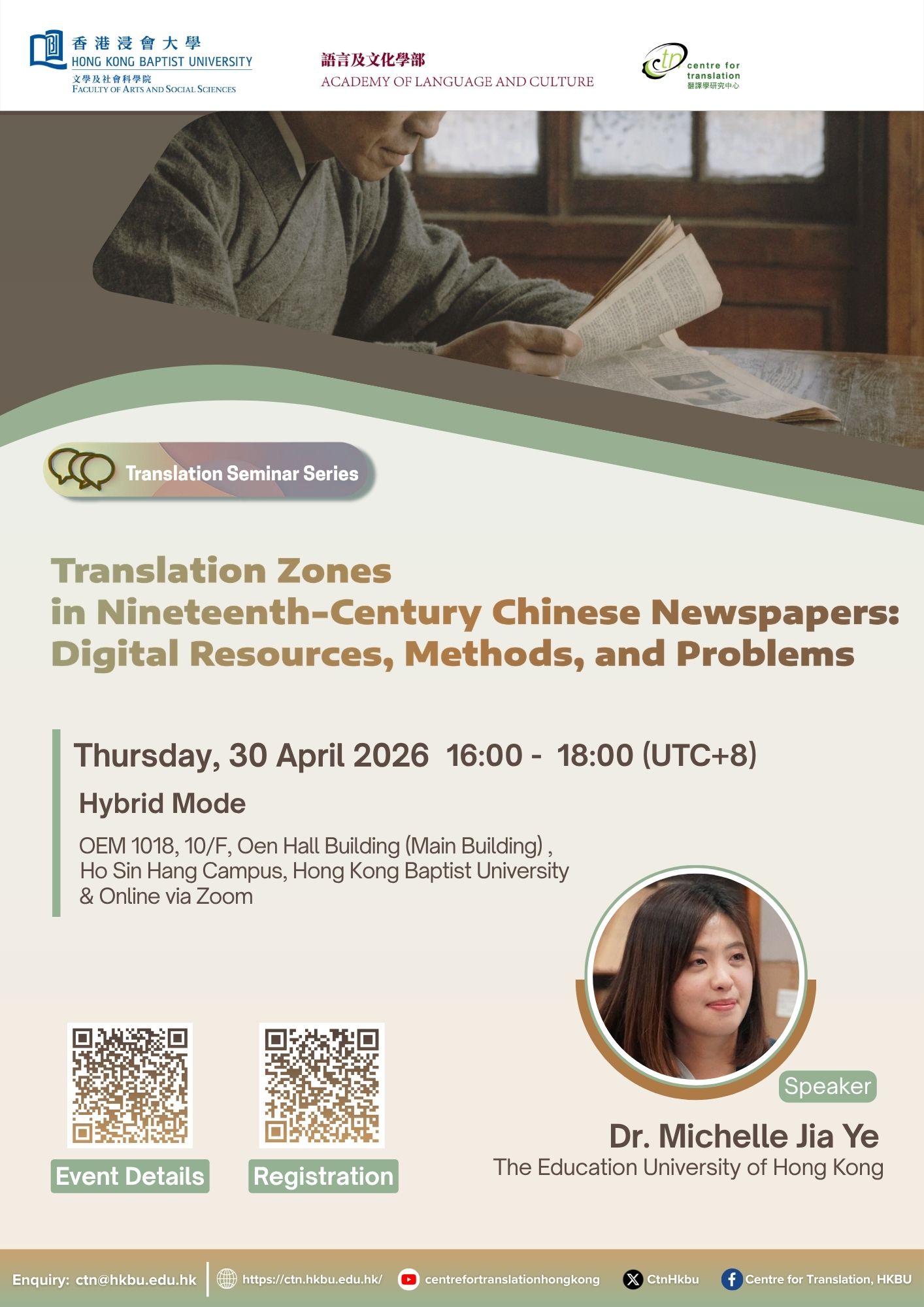
This lecture examines translation zones in nineteenth-century Chinese newspapers and the digital resources, methods, and problems revealed by ongoing research on early Cantonese run newspapers published in Shanghai, Guangzhou, and Hong Kong. These newspapers are rare but important primary sources that remain understudied across the humanities. Recent digitization and curated recovery efforts are expanding access and opening new possibilities to trace how languages, concepts, and power relations circulated within press cultures shaped by imperialism, nationalism, global commerce, and migration.
The rise of periodical studies as a distinct field in the 2010s provides conceptual tools that intersect productively with translation studies. Together, these fields reconceive newspapers as active sites of translational practice where linguistic difference, editorial labour, and sociopolitical interests meet and reshape public discourse. Drawing on selective case studies, the lecture shows that translation zones in nineteenth-century Chinese newspapers encompass more than explicitly labelled translations such as translated news items and editorials. They also include discursive translational matters embedded in journalistic practice. Reports about language barriers, claims about the presence or absence of multilingual intermediaries, and Chinese transliterations of foreign names all register translational work and anxieties that deserve theoretical attention.
Several methodological challenges emerge from the case studies. First, these phenomena require methods that move beyond linear models of source text to target text. Newspaper ecologies circulated information through multi-pronged networks of reprinting and mediation that resist simple directional narratives. Digital humanities tools now make it possible to map such networks at scale, but they also multiply pathways in ways that complicate decisions about research scope and analytical restraint. Second, identifying translation zones often demands specialized knowledge of historical language varieties, dialect repertoires, and the period media landscape, especially when tracing sources through back translation of Chinese transliterations. Consulting historical bilingual lexicons can help but introduces additional complexity. Third, close analysis of contested events refracted differently across languages and media requires interdisciplinary collaboration drawing on history, media studies, linguistics, literary studies, and religious studies. Fourth, translational practices in the press are frequently dispersed, heterogeneous, and resistant to tidy narratives, which makes systematic recovery slow and resource intensive. Fifth, there is the practical risk that discoveries in periodicals will overlap with findings available from other archival genres, complicating funding and publication prospects.
To the above challenges, digital methods and artificial intelligence offer promising responses. Building curated corpora for computational analysis and generative text mining is essential, but it requires time and funding that often exceed the means of early career researchers. The lecture concludes by arguing that collaborative infrastructure and sustained curation are necessary conditions for rigorous study of nineteenth-century translation zones in the press.
About the Speakers:
Dr. Michelle Jia YE (葉嘉) is Assistant Professor at the Department of Chinese Language Studies at the Education University of Hong Kong. Trained in translation studies, she publishes bilingually on transcultural and translingual practice in 19th- and 20th- century Chinese periodical press in reputable venues, including Modern Chinese Literature and Culture, Translation Studies, and Journal of Chinese Studies. She authored a monograph (2021) on translation in early Republican Shanghai literary journals, and published Chinese translations of social scientific works. Her work has been supported by Early Career Scheme (ECS), General Research Fund (GRF), and Collaborative Research Fund (CRF) awarded by the Research Grants Council of University Grants Committee, HKSAR. She is completing her second monograph, which traces the emergence of early Chinese cinematic knowledge in Chinese periodical writings circa 1900.
Dr. Ye is one of the nine Co-Principal Investigators of the cross-institutional CRF project titled “Lingnan Culture and the World: Construction and Change in the Cultural Landscape of Cantonese Literati from the late Qing to the Republican era in China (1821–1949)” (C4006-22GF). Her ongoing research in the project reconstructs the transpacific cultural enterprise of Cantonese bilinguals in the 19th century from their lexicons and newspapers, engaging pressing themes such as language, trade, wealth, migration, labour, education, and media representation.
Background Readings:
Apter, Emily (2011). The Translation Zone: A New Comparative Literature.
Princeton: Princeton University Press.
Gentz, Natascha (2007). “Useful Knowledge and Appropriate Communication: The Field of Journalistic Production in Late Nineteenth Century China.” In Rudolf G. Wagner ed. Joining the Global Public : Word, Image, and City in Early Chinese Newspapers, 1870–1910 (Albany, NY : State University of New York Press), 56–62.
Translation and/in Periodical Publications. Special issue of Translation and Interpreting Studies 14:2 (2019).
Visualizing Periodical Networks. Special Issue of The Journal of Modern Periodical Studies 5:1 (2014).