Translation Research Summer School
While traditionally focused on written and oral texts as the locus of translation activity and the primary object of investigation, the study of translation and interpreting has widened its scope considerably since the turn of the century, in response to major developments in the social, economic, political, environmental and technological spheres. Now widely understood as an interdiscipline rather than an inward looking field interested only in professional practice and textual analysis, translation studies no longer reduces its primary object to linguistic units but has sought to incorporate within its remit various types of non-verbal material as well as the different agents who produce translated texts and mediate oral interaction, and the cultural, historical and social environments that influence and are influenced by cultural agents and their production. The definition of ‘translation’ itself has been extended to encompass a wide range of activities and products that do not necessarily involve an identifiable relationship with a discrete source text.
Against this background, the Translation Research Summer School aims to offer cutting-edge, intensive research training that addresses the evolving needs of doctoral and early career researchers in translation and interpreting studies, as well as those of more experienced academics who are new to the discipline or interested in engaging with recent developments in the field. In addressing new themes and revisiting old ones from fresh perspectives, the School provides a solid foundation for conducting research in the field and equips prospective researchers with the intellectual and practical tools to launch their own independent projects.
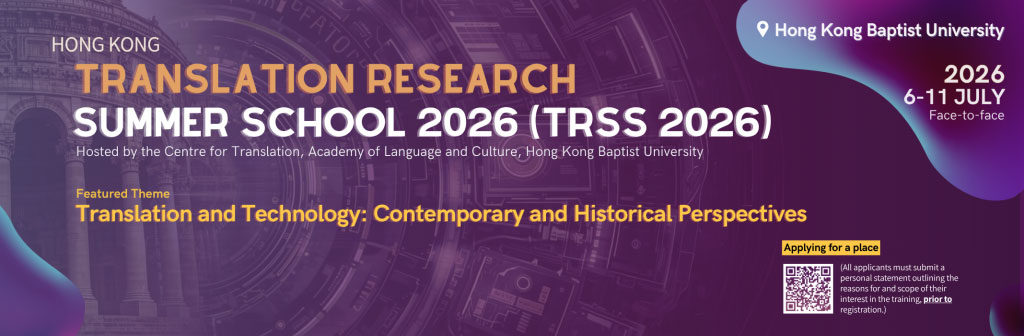
The Translation Research School took place at Shanghai International Studies University in June/July 2022 and 2024, and will take place again at Hong Kong Baptist University in 2026 and every other year thereafter, alternating with the International Research School for Media Translation and Digital Culture.
School Aims and Objectives
- To introduce students to the latest developments in research models, methodologies and techniques;
- To help students develop research skills specific to translation and intercultural studies;
- To offer critical assessments of available resources and relevant approaches;
- To lend individual support in designing and planning research projects.

Conceptual Remit
The Translation Research Summer School delivers a coherent programme divided into five modules, as follows:
- Theoretical approaches: this module prioritizes more recent theoretical advances in the discipline rather than traditional frameworks.
- Research Methods: focusing on methodologies that are particularly relevant to researching the featured theme selected for the current year.
- Research Design and Dynamics: including case studies showcasing specific methodologies.
- Featured Theme: a special theme is selected for each edition of the School.
- Academic Career Development: to cover areas such as publishing academic papers; securing an early career post; managing a PhD project; and preparing grant applications for external funding.


Syllabus and Organization
The School consists of five modules:

Module 1
Theoretical Approaches
2 x 90-minute sessions

Module 2
Research Methods
2 x 90-minute sessions

Module 3
Research Design & Dynamics
2 x 90-minute sessions

Module 4
Featured Theme
2 x 90-minute sessions

Module 5
Academic Career Development
2 x 90-minute sessions
Each module encompasses three contact hours and approximately six hours of guided reading.
On the last day of the School, each student presents their work to fellow students and staff and receives verbal feedback.
Students will spend their mornings in classes and workshops, while afternoons will be spent in small group tutorials and independent study. Each student will be provided with the opportunity to take part in three tutorials.
Students are allowed to choose one of two pathways:
Pathway 1 caters for participants working towards a completion certificate.
Pathway 1 students
- deliver a presentation of their proposed research project on the final day of the School;
- submit a research proposal (between 2,000 and 3,000 words long, excluding the bibliography) by the end of September;
- attend three group tutorials during the School.

Pathway 2
Pathway 2 caters for participants working towards an attendance certificate only.
Pathway 2 students
- choose whether they wish to attend tutorials during the school (they will have expressed their interest in doing so via their participation form);
- do not deliver a presentation nor submit a research proposal.
Students in Pathway 1 will deliver a presentation of their research project on the final day of the School.
Presentations should last 10 minutes, followed by a 5-minute discussion session. They provide an opportunity for students to receive feedback from their peers and tutors in attendance.
Pre-School
As part of the application process, and prior to registration, all participants are required to submit a Personal Statement outlining the reasons for and scope of their interest in the topics to be covered in the School. Applicants should submit their personal statement at this online platform. For academic queries, you may contact one of the School’s Academic Directors: Mona Baker / Kyung Hye Kim.
Post-School
Participants wishing to receive a Completion Certificate are required to submit a Research Project Proposal (between 2,000 and 3,000 words long, excluding the bibliography) within three months of attending the School. Guidelines for writing the proposal are provided during the Research School.
Completion Certificates are issued to the Pathway 1 applicants whose proposal is deemed satisfactory by the School tutors and detail the number of contact hours and hours of guided reading completed.
Attendance certificates are issued to the Pathway 2 participants at the end of the School.
Teaching Staff
The School is staffed by a core group of visiting and local academics. Additional tutors are involved on a one-off basis on different years, as required by the relevant featured theme. Not all members of the core group will necessarily be involved in each session of the School.
Change of tutor lineup for TRSS 2026 (updated 17 Jun 2026):
Professor Mona Baker has withdrawn from this year’s program due to unforeseen health reasons. Dr. Jan Buts (University of Oslo, https://www.med.uio.no/sustainit/english/people/aca/janbut/) will join TRSS 2026 as a tutor.
Mona Baker (Prof.)
Professor Mona Baker
Academic Director, Translation Research Summer School (TRSS)
Tutor, International Research School for Media Translation and Digital Culture (MTDC)
Mona Baker is Affiliate Professor at the Centre for Sustainable Healthcare Education (SHE) at the University of Oslo, co-cordinator of the Genealogies of Knowledge Research Network, and Honorary Dean of the Graduate School of Translation and Interpreting, Beijing Foreign Studies University. She is a recipient of the 2015 Kuwait Foundation for the Advancement of Sciences Award in the field of Arts and Languages, Studies in Foreign Languages and Literatures, and honoree of the 2011 Fifth Session of Abdullah Bin Abdulaziz International Award for Translation, for contributions to the field of translation. Baker is author of In Other Words: A Coursebook on Translation (third edition 2018) and Translation and Conflict: A Narrative Account (2006; Classics edition 2018), co-author (with Eivind Engebretsen) of Rethinking Evidence in the Time of Pandemics: Scientific vs Narrative Rationality and Medical Knowledge Practices, and editor of Translating Dissent: Voices from and with the Egyptian Revolution (2016; winner of the Inttranews Linguists of the Year award for 2015), Routledge Encyclopedia of Translation Studies (third edition 2020, co-edited with Gabriela Saldanha), Critical Concepts: Translation Studies (4 volumes, Routledge, 2009), and Critical Readings in Translation Studies (Routledge, 2010). She is also a founding co-editor of Encounters in Translation. Her articles have appeared in a wide range of international journals, including Humanities and Social Sciences Communications, Social Movement Studies, Critical Studies on Terrorism, Social Semiotics, The Translator and Target. She posts on translation, citizen media and Palestine on her personal website and tweets at @MonaBaker11.
Mona BAKER (Prof.)

Kyung Hye Kim (Dr.)

Dr. Kyung Hye Kim
Academic Co-Director, International Research School for Media Translation and Digital Culture (MTDC) & Translation Research Summer School (TRSS)
Kyung Hye Kim is Assistant Professor at Dongguk University, South Korea. She conducts interdisciplinary research on the various ways in which translation impacts and shapes cross-cultural communication and challenges dominant discourses in society, particularly in the areas of corpus-based translation studies and in audiovisual translation. She is a member of the Genealogies of Knowledge Research Network, and Chair of the Conference Committee of IATIS, the International Association for Translation & Intercultural Studies, and Chair of the International Cooperation Committee of the Korean Association for Translation Studies.
Kyung Hye KIM (Dr.)
Jan Buts (Dr.)
Dr. Jan Buts
Tutor, Translation Research Summer School (TRSS)
Dr. Jan Buts is an Associate Professor in the Sustainable Health Unit at the University of Oslo. His interdisciplinary work is situated at the intersection of translation theory, medical humanities, conceptual history, and corpus linguistics. He is actively involved in developing the Sustainability and Health Corpus and teaches courses on sustainable health, narrative medicine, and public health politics. Dr. Buts holds a PhD in Translation and Intercultural Studies from the University of Manchester and has previously held academic positions in Ireland and Turkey.
Jan BUTS (Dr.)
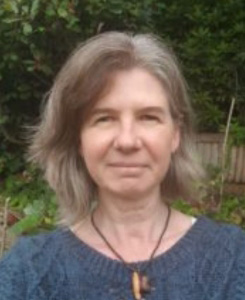
Sue-Ann Harding (Prof.)
Professor Sue-Ann Harding
Tutor, Translation Research Summer School (TRSS)
Sue-Ann Harding is Professor in Translation and Intercultural Studies at Queen’s University Belfast, where she is the Director of the Centre for Translation and Interpreting. Her research interests are in social narrative theory as a mode of inquiry into translations and translated events, with a particular interest in sites of conflict and narrative contestation. She has a diverse research profile, publishing on online reportage, translations and commemorations of Russia’s 2004 Beslan hostage disaster; Qatar’s efforts to use institutional translation to cultivate a literary and culturally-engaged population; the translation of police interviews in South Africa; Arabic and Russian translations of Frantz Fanon’s writings; resonances between narrative and complexity theory; and translation processes in NGO development impact assessment research projects in Africa’s Sahel. She is the author of Beslan: Six Stories of the Siege (Manchester University Press, 2012); and co-editor (with Kathryn Batchelor) of Translating Frantz Fanon Across Continents and Languages (Routledge, 2017) and (with Ovidi Carbonell Cortés) of The Routledge Handbook of Translation and Culture (2018) She is the Chair of the Executive Council for the International Association of Translation and Intercultural Studies (IATIS), Reviews Editor for The Translator (Taylor and Francis), a member of the awards committee for The Martha Cheung Award for Best English Article in Translation Studies by an Early Career Scholar (Centre for Translation, Hong Kong Baptist University) and served as an ARTIS Associate (Advancing Research in Translation and Interpreting Studies). She is writing a book on archival, historical and contemporary narratives that translate the natural and urban landscapes of Qatar.
Sue-Ann HARDING (Prof.)
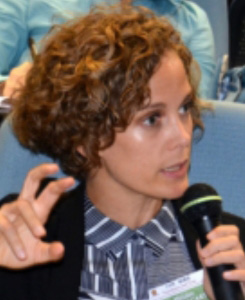
Maialen MARIN-LACARTA (Dr.)
Dr. Maialen Marin-Lacarta
Tutor, Translation Research Summer School (TRSS)
Maialen Marin-Lacarta is Associate Professor at the Department of Translation, Interpreting and East Asian Studies of the Autonomous University of Barcelona. Prior to joining UAB, she was Senior Researcher at the Open University of Catalunya, where she was Principal Investigator of the DigiTrans project. Between 2014 and 2020, she was Assistant Professor in the Department of Translation, Interpreting and Intercultural Studies at Hong Kong Baptist University, where she received the President’s Award for Outstanding Performance as Young Researcher in 2019. She is also the awardee of the Jokin Zaitegi Basque National Award for her translation of Nobel Prize winner Mo Yan’s work into Basque (with Aiora Jaka), and the recipient of two General Research Fund grants by the University Grants Committee of Hong Kong (as Principal Investigator) and four Spanish government-funded grants (one as PI and three as Co-Investigator). Marin-Lacarta has published her research in Basque, French, Spanish, Chinese and English (in journals such as The Translator, Translation Studies, Perspectives and Meta). She has guest edited a special issue on Ethnographic Research in Translation and Interpreting Studies (with Chuan Yu) for The Translator and is the co-editor of 1611: A Journal of Translation History.
Maialen MARIN-LACARTA (Dr.)
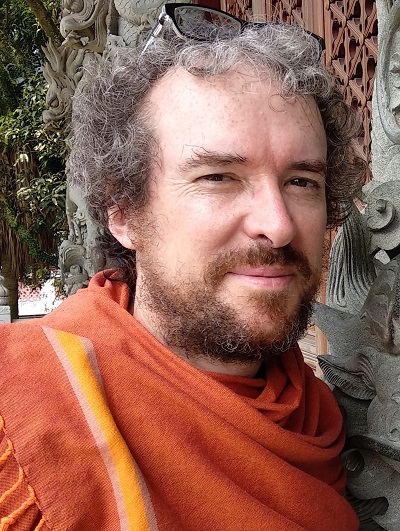
NEATHER, Robert J (Dr.)
Research Fellow
| rneather@hkbu.edu.hk | |
| Telephone | (+852) 3411 2309 |
| ORCID | https://orcid.org/0000-0002-8313-9870 |
Profile
- Associate Professor, Department of Translation, Interpreting and Intercultural Studies
- United Nations certified translator and editor (Chinese/French into English)
- Member, IATIS Executive Council
Education
- Pg. Dip. in Interpreting and Translating (Chinese), University of Bath (1999)
- Ph.D. in classical Chinese literature, Queens’ College, University of Cambridge
Thesis: “The Fu Genre in the Mid-Tang: A Study in Generic Change” (1995) - B.A. in Chinese (double First Class), Queens’ College, University of Cambridge (1989)
Honours, Awards and Grants
- GRF grant (2015 – 2019) for project: “Collaborative Practice in Contemporary Buddhist Translation Communities”.
- GRF grant (2008 – 2011) for project: “Museums, Language and Cross-Cultural Communication: Bilingual/Multilingual Museum Texts and their Production”
- UN Competitive Examinations for English Language Translators/Précis-writers (passed 2009)
- UN Competitive Examinations for English Language Editors (passed, 2009)
Download/View CV
I have taught various courses in translation and interpreting since 1999, first at the University of Bath and then at City University of Hong Kong, before joining HKBU in 2007. My course teaching has been mainly in areas such as translation methodology and English stylistics. I also supervise projects at BA, MA and PhD levels. The courses that I have taught at HKBU include the following:
BA
- Introduction to Translation
- Principles and Methods of Translation
- English for Translators: Grammar, Structure and Style
- English for Translators II: Written Genres
- Communication and Translation
- Reading Chinese Literature in Translation
- Research Methods for Translation Studies
MA
- Bilingual Writing for Creative Industries
- Methods and Strategies of Translation
PhD
- Essential Readings
- NEATHER, Robert (2021) “Museums as Translation Zones”. In E. Bielsa and D. Kapsaskis (eds), The Routledge Handbook of Translation and Globalization, London: Routledge, pp. 306-319.
- NEATHER, Robert (2020) “Continuity and Change in Chinese Buddhist Discourse on Translation: Conceptions of Translation in Modern Buddhist Translator Guidelines”. Interventions: International Journal of Postcolonial Studies. (DOI: 10.1080/1369801X.2020.1854101)
- NEATHER, Robert (2020) “Buddhism and Buddhist Texts”. In Mona Baker and Gabriela Saldanha (eds) The Routledge Encyclopaedia of Translation Studies, 3rd Edition, London and New York: Routledge, pp. 70-75. (DOI: 10.4324/9781315678627)
- NEATHER, Robert (2020) “Collaborative Translation”, in Mona Baker and Gabriela Saldanha (eds) The Routledge Encyclopaedia of Translation Studies, 3rd Edition, London and New York: Routledge, pp. 70-75. (DOI: 10.4324/9781315678627)
- NEATHER, Robert (2019) “Argumentation and Generic Change in the Mid-Tang Fu: Li Guan’s (766-794) ‘Fu on Suffering the Pitiless Rains’ and the Role of the Shelun Genre”. In N.M. Williams (ed.), The Fu Genre of Imperial China: Studies in the Rhapsodic Imagination. Leeds: Arc Humanities Press, and Amsterdam: Amsterdam University Press, pp. 141-168.
- Neather, Robert (2018) “Museums, Material Culture, and Cultural Representations”. In Sue-Ann Harding and Ovidi Carbonell Cortés (eds) The Routledge Handbook of Translation and Culture, London and New York: Routledge, pp. 361-378.
- Neather, Robert (2014) “Visual Paratexts in Literary Translation: Intersemiotic Issues in the Translation of Classical Chinese Literature”. In Sandra Bermann and Catherine Porter (eds), A Companion to Translation Studies, Oxford: Wiley-Blackwell, pp. 504-515.
- Neather, J. (2012) “‘Non-Expert’ Translators in a Professional Community: Identity, Anxiety and Perceptions of Translator Expertise in the Chinese Museum Community”. The Translator 18 (2012): 245-268. (DOI: 10.1080/13556509.2012.10799510)
- Neather, Robert (2012) “Intertextuality, Translation and the Semiotics of Museum Presentation: The Case of Bilingual Texts in Chinese Museums”. Semiotica 192 (2012): 197-218. (DOI: 10.1515/sem-2012-0082)
- Neather, R.J. (2009) “Translation in a ‘Non-Translation’ Community: Practices, Ideologies and Conceptualizations of Translation in the PRC Museum Discourse Community”. Translation Quarterly 51&52 (December 2009): 145-176.
- Neather, R. (2008) “Translating Tea: On the Semiotics of Interlingual Practice in the Hong Kong Museum of Tea Ware.” META: Translators’ Journal, 53.1 (March 2008): 218-240. (DOI: 10.7202/017984AR)
- Neather, J. (2003) “The Translation of Generic Designations: The Case of the Fu Genre”. In Translation Quarterly 30: 1-26.
Research Interests
My research incorporates a strong interest in translation in intersemiotic environments and has focused particularly on the Chinese museum context. I have explored various issues in this area, including verbal/visual interactions in translation and the effects that such interactions have on translation strategy in the museum space; intertextuality in the construction of bilingual museum narratives; and issues of expertise and community identity in the collaborative production of translations, specifically in the Hong Kong/Macau/Guangzhou area. As a next step forward, I hope to move my research into the area of visitor studies, an aspect that has previously seldom been considered in the bilingual or translation context.
More recently, after involvement as a consultant in a monastic translation project, I have also started exploring translation in contemporary Buddhist volunteer translator communities, the subject of my GRF funded project. I am interested in issues such as how the members of such communities interact in producing finalized translation output, questions of authority and hierarchy in community structure, and how democratizing mechanisms foster inclusiveness among novice members. I am also interested in exploring the more theoretical implications of these communities, particularly how they can contribute to the theorization of Communities of Practice (CoP).
Research Specializations
- Translation in museum and heritage sites
- Collaborative translation and translation communities
- Buddhist translation
Professional Translation Work
A wide variety of freelance work undertaken (from 1999) for a variety of clients. Numerous major freelance assignments undertaken for the United Nations Office in Geneva (UNOG).
Published Translations (selection)
- Neather, R.J. (co-translator and editor) (2008), Dreaming of a Northern Land (translations of selected essays of Wang Chonglü, with editor/translator’s preface). Shenyang: Liaoning Educational Press, in with Bertelsmann, Berlin, 164 pages.
- Poon, Ka-Man, and R.J. Neather (co-translators) (2007), “The Romance of the Rib”. In J. Minford, B. Holton and A. Chan, eds., Islands and Continents: Short Stories by PK Leung. Hong Kong: Hong Kong University Press, pp. 11-19.
- Poon, Ka-Man, and R.J. Neather (co-translators) (2004), “Kamdu Tea Restaurant”, story by Chan Koon In The Literary Review (AHCI listed), Summer 2004, vol. 47, issue 4, pp. 138-153.
- Neather, R.J. (2003), “Cultural Exchange and the Quest for Immortality: the Heavenly Horses of the West and the Divine Dragon of China”, by Huo Wei, in Ex/Change, February 2003, pp. 9-13. (Translation of an unpublished Chinese original).
- Neather, R.J. (2002), “Yu Qian (Before The Rain)”, by He Qifang. In Zhongguo Fanyi, 23(4), July 2002, pp 95-96. (Translation, with Chinese annotation). Republished in Yang Ping 楊平(ed), Mingzuo Jingyi: Han Yi Ying XuanCui 名作精譯 –《中國翻譯》漢譯英選萃, Qingdao: Qingdao Chubanshe, 2003, pp.362-368.
Robert John NEATHER (Dr.)
General Queries
For administrative queries, please contact us at ctn@hkbu.edu.hk.