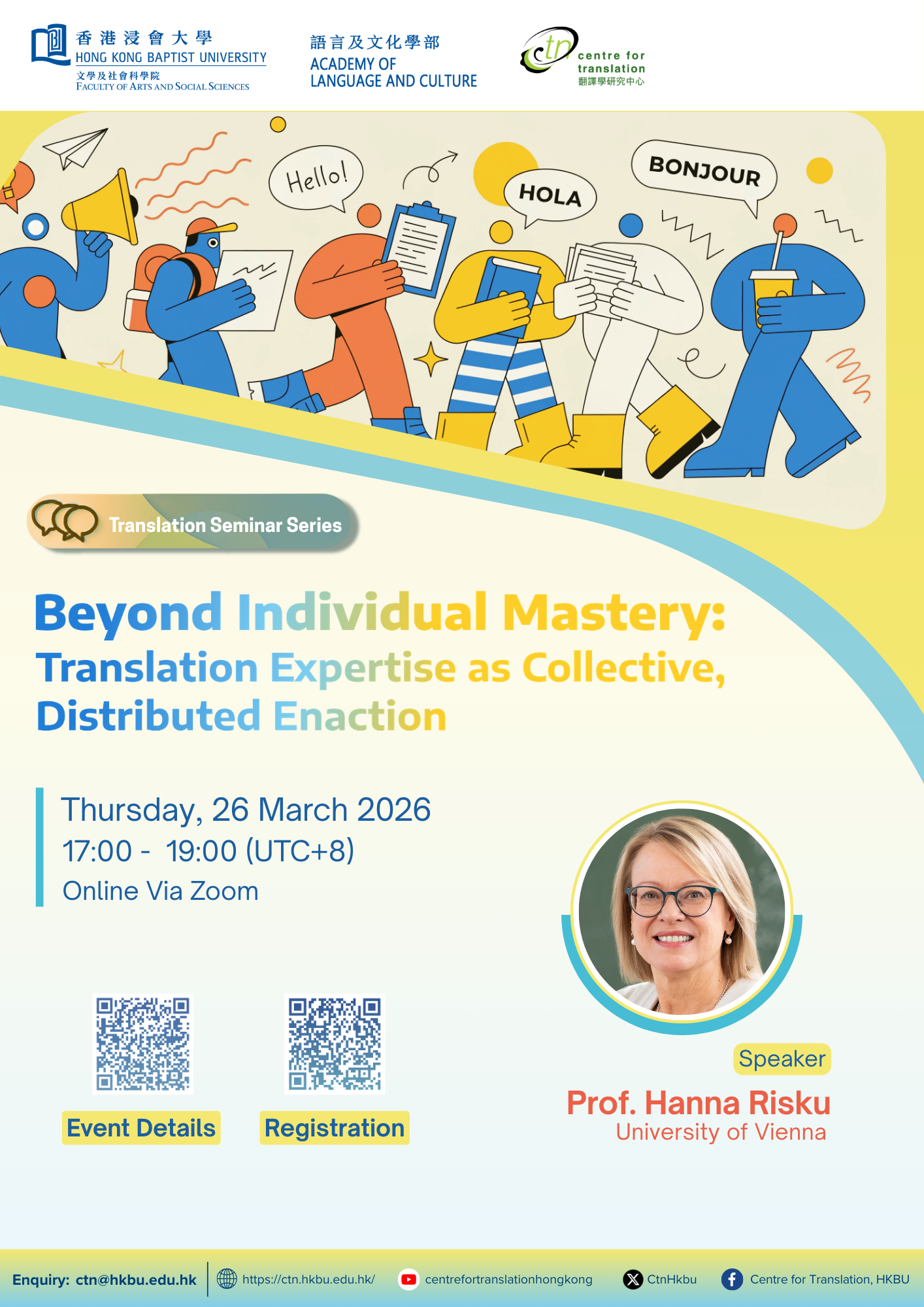
Beyond Individual Mastery: Translation Expertise as Collective, Distributed Enaction
Time
5:00 pm - 7:00 pm
Location
Online via Zoom
Speaker
Prof. Hanna Risku (University of Vienna)
Research on expertise in translation studies has largely focused on the skills and performance of individual translators. However, there is a growing body of research which demonstrates that translation practices are collaborative and embedded in complex socio-material environments. In this seminar, I outline how expertise research in translation studies can be enriched by adopting perspectives from socio-cognitive approaches and from research on distributed, team, and organizational expertise in other disciplines.
In our field research project Rethinking Translation Expertise: A Workplace Study (RETREX), we follow an inductive approach that seeks to identify recurring themes in the field. Three private translation agencies and one translation department in a public institution opened their doors for us for several weeks and allowed us to observe them and their practices, conduct interviews, and collect documents. In addition, two focus group discussions were conducted: one with translation agency CEOs, and one with translators. This way, we were able to gather perspectives of professionals with different roles and tasks in translation practice, including salaried translators and project managers, freelance translators, and self-employed translation agency CEOs. Drawing on the ethnographic data, we analyze how expertise is enacted, coordinated, and recognized across actors, artifacts, and organizational structures.
The insights regarding the distributedness of translation expertise are summarized along five dimensions: (1) sharing identities, (2) acting as a social unit, (3) learning as a social unit, (4) interweaving material affordances, and (5) realigning processes. For example, a democratic understanding of leadership and learning could be observed, giving testimony to the notion of learning organizations that integrate the learning process of individuals into the organization as a whole. Furthermore, expertise here not only means knowing something but also knowing how to handle not knowing, and how to handle disruptions and limitations.
We shift the focus from individual skills to shared identities, from rational strategies to affective assessments, and from absolute process characteristics to relative options of activity. Thus, we aim to advance the conceptualization of translation expertise beyond notions of individual mastery and to open up new directions for empirical research.
Hanna Risku is professor for translation studies and head of the Research Group Socio-Cognitive Translation Studies (socotrans) at the University of Vienna, Austria. Her research areas include translation and cognition, translation workplace and network research, and translation expertise. Prior to her work in Vienna, she was professor for translation studies at the University of Graz, professor for applied cognitive science and technical communication, head of the Department for Knowledge and Communication Management and vice rector at the Danube University Krems, guest professor at the University of Aarhus, Denmark, and lecturer at different universities in Austria, Finland and Sweden. In 2010, she was awarded the TCeurope Award for Services to Technical Communication in Europe. In 2023, she was CETRA Chair professor at KU Leuven and DOTTSS Guest professor at Tampere University. She is a member of the Finnish Academy of Science and Letters.
Sannholm, R., and H. Risku. 2024. “Situated Minds and Distributed Systems in Translation.” Target. International Journal of Translation Studies 36 (2): 159–183. https://doi.org/10.1075/target.22172.san
Schlager, D., and H. Risku. 2024. “What Does It Take to Be a Good In- House Translator? Constructs of Expertise in the Workplace.” JoSTrans 42: 2–19. https://doi.org/10.26034/cm.jostrans.2024.5976
Schlager, D., and H. Risku. 2023. “Contextualising Translation Expertise: Lived Practice and Social Construction.” Translation, Cognition & Behavior 6 (2): 231–252.
Risku, H., and R. Rogl. 2022. “Praxis and Process Meet Halfway: The Convergence of Sociological and Cognitive Approaches in Translation Studies.” The International Journal of Translation and Interpreting Research 14 (2): 32–49. https://doi.org/10.12807/ti.114202.2022.a03
Risku, H., and R. Rogl. 2021. “Translation and Situated, Embodied, Distributed, Embedded and Extended Cognition.” In The Routledge Handbook of Translation and Cognition, ed. by F. Alves, and A. L. Jakobsen, 478–499. London: Routledge.
Research Group Socio-Cognitive Translation Studies (socotrans): https://socotrans.univie.ac.at/
Research Project Rethinking Translation Expertise: A Workplace Study (RETREX): https://socotrans.univie.ac.at/retrex-fwf-project/